Address
Universe Star, Shangding Road, Zhengzhou, Henan
Email
[email protected]


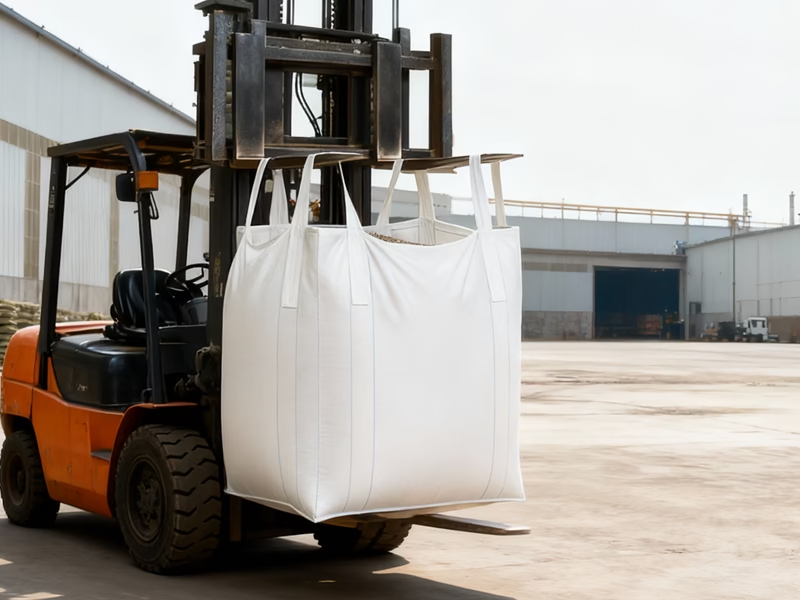
In today’s fast-paced industrial landscape, Flexible Intermediate Bulk Containers (FIBCs)—commonly known as bulk bags—have revolutionized how we store and transport everything from fine pharmaceutical powders to coarse construction aggregates. These versatile workhorses offer remarkable efficiency, cost-effectiveness, and sustainability benefits. However, their safe handling demands rigorous attention to detail, comprehensive training, and strict adherence to established safety protocols that go far beyond simple “common sense.”
At ApexFIBC, safety isn’t merely a compliance checkbox; it’s the foundational principle that guides every recommendation we make. This comprehensive guide distills critical safety and design principles from the industry’s most authoritative source—the Flexible Intermediate Bulk Container Association (FIBCA)—to help you build a culture of safety that protects your most valuable assets: your people, your products, and your operational continuity.
Before examining specific protocols, it’s crucial to grasp why FIBC safety demands such unwavering attention. A single standard bulk bag can safely contain anywhere from 500 to 4,000 pounds of material. When improperly handled, these massive loads can cause catastrophic injuries, devastating product loss, environmental contamination, and financial liability that can reach millions of dollars.
The global FIBC market serves increasingly diverse sectors—chemical processing, food production, pharmaceuticals, mining, agriculture, and construction. With over 100 member companies spanning 25+ countries across five continents, FIBCA represents an industry united in its commitment to education, standardization, and safety excellence. Their guidelines reflect decades of accumulated knowledge, rigorous incident analysis, and engineering best practices that have evolved through real-world experience.
Here’s the critical reality that every organization must internalize: ultimate responsibility for safety rests entirely with your company. As FIBCA emphatically states, “IT IS THE RESPONSIBILITY OF EACH INDIVIDUAL COMPANY TO ENSURE THAT ITS HANDLING GUIDELINES ARE REASONABLY APPROPRIATE UNDER THE CIRCUMSTANCES AND COMPLY WITH THE LAW.” These guidelines provide the framework; your leadership and daily execution bring them to life.
The journey toward incident-free FIBC operations begins months before the first bag enters your facility. Consulting with your manufacturer or supplier to select the right FIBC for your specific product and distribution environment is not optional—it’s the single most important decision you’ll make. This is never a one-size-fits-all proposition; different applications demand vastly different bag constructions, materials, and safety features.
When sourcing your FIBC package, you’ll need to answer critical questions that directly impact safety and performance:
Product Characteristics:
Operational Requirements:
These details aren’t mere paperwork—they’re essential data points that enable your supplier to engineer a bag that will perform safely in your specific environment. ApexFIBC’s expert team guides clients through this discovery process, ensuring every critical parameter is considered before manufacturing begins.
Every single FIBC must undergo thorough inspection before each use. This is not a step to rush during busy production periods. Never handle a damaged FIBC without consulting your manufacturer or supplier about its suitability for continued service. Damage can manifest in ways that aren’t immediately obvious but create catastrophic failure risks:
Create a standardized, documented inspection checklist and train all personnel to complete it rigorously. Bags that fail inspection must be immediately tagged and isolated from service. Many suppliers, including ApexFIBC, offer professional damage assessment services to determine if repairs are feasible or if retirement is required.
Your FIBC manufacturer provides specific recommendations for a reason—they understand the precise engineering limitations and performance characteristics of their products. Adhere to all FIBC manufacturer’s recommendations and any information printed on the label or tag. These specifications include:
These aren’t suggestions or guidelines—they’re engineered safety parameters derived from rigorous testing. Exceeding them, even marginally, eliminates the safety margin designed to protect your operations.
Understanding FIBC design options is fundamental to safe operation. The wrong design for your application creates inherent safety risks, while the optimal design enhances both safety and efficiency.
The choice between Type A, B, C, or D FIBCs is perhaps the most critical safety decision you’ll make:
Type A: Standard bags with no static protection—NEVER use in flammable or explosive environments or with combustible materials.
Type B: Made from materials with low breakdown voltage that can sustain up to 6kV. They prevent propagating brush discharges but do not require grounding. Suitable for dry, flammable powders but NOT for flammable solvents or gases.
Type C: Constructed with conductive threads in a grid pattern that MUST be securely grounded throughout filling and emptying operations. These are essential for many hazardous environments but demand strict adherence to grounding protocols.
Type D: Made from static dissipative materials that safely dissipate charge without grounding. However, they must be used strictly according to manufacturer specifications regarding environmental conditions and cleanliness.
Making the wrong choice here can result in catastrophic explosions. Conduct a thorough hazard assessment of your facility, and consult with experts to verify your static protection requirements.
Many applications require liners for moisture barrier, product purity, or chemical compatibility:
Critical safety point: For Type C applications, conductive liners must be properly connected to the bag’s grounding system. Failure to integrate liner and bag grounding can create isolated charge buildup—exactly what you’re trying to prevent.
Electrostatic discharge represents the most misunderstood and dangerous hazard in FIBC operations. In environments containing flammable vapors, gases, or combustible dusts, a single static spark can trigger explosions with devastating consequences. The IEC 61340-4-4 Standard provides the definitive framework for static protective FIBCs, and compliance is literally life-or-death.
If your hazard assessment determines you need Type C conductive bags, these rules are absolute:
All conductive objects and materials—including personnel through conductive footwear, plant machinery, and tools—must be properly grounded in hazardous environments. A chain is only as strong as its weakest link.
Before any product enters the bag:
Never exceed the Safe Working Load (SWL) specified on the bag. Overfilling doesn’t just overload the fabric—it makes the bag unstable and prone to tipping.
Don’t fill beyond stable dimensions. While a typical maximum height-to-width ratio is 2:1, always reference current industry standards for your specific application. An overly tall, narrow bag is inherently unstable and will tip during normal handling.
Handling devices must be specifically designed for FIBCs, equipped with safety latches, rated for the filled capacity, and adhere to approved handling methods. Improvised solutions kill people.
For forklift operations:
Lift loop integrity is non-negotiable. These fabric loops are the literal lifeline connecting your load to handling equipment:
Inappropriate pallets cause more FIBC damage than any other storage factor:
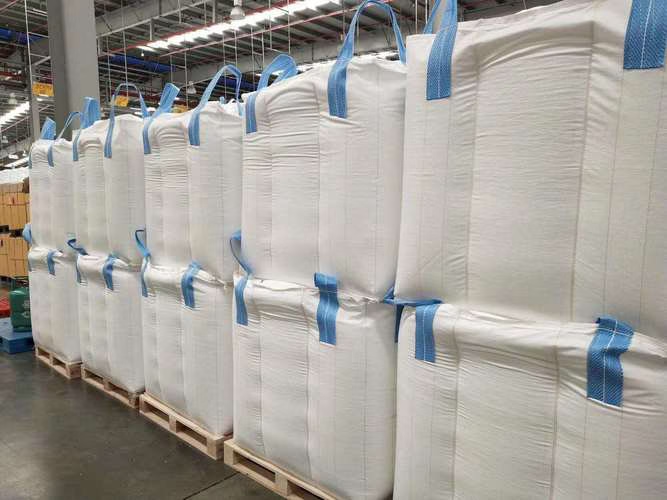
Only stack FIBCs if they are specifically designed for stacking, you have verified stability, and you use approved methods:
Pyramid Stacking: Each bag above the base layer sits on at least four lower bags, with each tier stepping inward. This method is inherently stable and self-supporting.
Supported Stacking: Bags stack against two retaining walls of sufficient strength to withstand lateral forces. Warehouse walls are NOT automatically suitable—walls must be engineered for this specific load.
Critical safety rule: Never approach or attempt to repair a damaged bag while others remain stacked on top. The entire stack’s stability may be compromised.
Environmental exposure degrades FIBC strength invisibly, often until catastrophic failure:
UV Radiation: Always protect FIBCs from sunlight and harmful UV rays. Polypropylene fibers undergo photodegradation that dramatically reduces tensile strength. Even a few weeks of direct summer sun can compromise a bag’s integrity. Store indoors or under opaque, UV-blocking covers.
Moisture and Weather: Protect FIBCs from rain, snow, and humidity. Water absorption leads to mold, product contamination, and fiber degradation. It also creates slip hazards and can cause hygroscopic materials to cake.
Outdoor Storage Warning: While sometimes unavoidable, outdoor storage is not recommended. If absolutely necessary, cover with materials that prevent UV and moisture exposure. However, FIBCA does not endorse outdoor storage, and it occurs solely at your own risk. There is no guarantee that unprotected outdoor storage will leave FIBCs safe to use.
Secure FIBCs adequately during transport using appropriate load bars, strapping, and containment. Prevent shifting that causes impact damage or load instability. Avoid sudden acceleration or braking—transport drivers need FIBC-specific safety training.
Here’s a truth that surprises many experienced operators: As of the present date, FIBCA is not aware of any definitive data, test reports, or studies determining the shelf life of an FIBC. Any shelf life claims are the sole responsibility of the company making them.
There is no standard “five-year rule” or any arbitrary timeframe. FIBC longevity depends on a complex interaction of variables:
The best method for determining if an FIBC remains suitable for use is to conduct periodic performance testing (top lift testing, UV resistance testing, etc.) on representative samples. Compare results to baseline data from newly manufactured samples of the same specification. Sample results should continue to meet industry standards such as ISO 21898.
Implement a quarterly or semi-annual testing program for inventory exceeding six months of age. This proactive approach prevents failures and demonstrates due diligence in liability situations.
While most static protective FIBCs use inherently conductive materials that don’t degrade, some designs rely on anti-static additives incorporated during manufacturing or applied as topical finishes. These additives typically have reduced shelf life and are more sensitive to environmental hazards than standard materials.
If your FIBCs contain anti-static additives, obtain specific storage and handling guidance from your manufacturer. These bags may require climate-controlled storage and have shorter usable lifespans. Always verify anti-static performance before use in safety-critical applications.
Implementing these comprehensive safety and design guidelines requires more than reading a document—it demands a partnership with experts who understand your unique operational challenges. At ApexFIBC, we differentiate ourselves through:
Expert Design Consultation: Our technical team walks you through the entire design guide, ensuring every parameter—from bulk density to static protection needs—is properly specified before production begins.
Custom Engineering: We don’t just sell stock bags. We engineer solutions specifically for your application, considering your handling equipment, storage environment, and regulatory requirements.
Comprehensive Training: We provide on-site training for your operators, supervisors, and safety managers, covering inspection, handling, and emergency procedures tailored to your specific bag designs.
Testing and Quality Assurance: Our manufacturing follows strict quality protocols, and we support your ongoing shelf-life testing programs with baseline data and technical assistance.
Regulatory Navigation: Whether you’re dealing with FDA requirements for food contact, UN certification for hazardous materials, or pharmaceutical-grade standards, we help you navigate the regulatory landscape.
Continuous Support: When questions arise about damaged bags, storage concerns, or new applications, our technical experts are a phone call away, providing the guidance you need to make safe decisions.
Safe FIBC handling isn’t about memorizing a list of rules—it’s about embedding a safety-first mindset into every operational decision. The guidelines we’ve detailed represent industry best practices developed through decades of experience, incident analysis, and engineering refinement. They work only when combined with:
Remember, these guidelines address common situations but cannot cover every unique circumstance. Always consult your FIBC manufacturer or supplier regarding your specific application and handling environment. Variables such as product reactivity, facility layout, climate extremes, and equipment capabilities require customized safety approaches.
The Flexible Intermediate Bulk Container Association provides extensive educational resources, and we encourage exploration of their materials at www.fibc-a.com. Additionally, the ApexFIBC team stands ready to support your safety initiatives with expert guidance, product selection assistance, and training programs designed specifically for your workforce.
Contact ApexFIBC today to schedule a comprehensive safety and design assessment of your FIBC operations. Our experts will evaluate your current practices, help you identify improvement opportunities, and engineer bag solutions that optimize both safety and operational efficiency. Together, we can build a bulk handling system that protects your people, preserves your product integrity, and enhances your profitability.
This guide synthesizes FIBCA Safe Handling Guidelines Version 2.0 (July 2017) and FIBCA Design Guide principles. Always consult current standards and your specific supplier documentation for the most up-to-date requirements.