Address
Universe Star, Shangding Road, Zhengzhou, Henan
Email
[email protected]


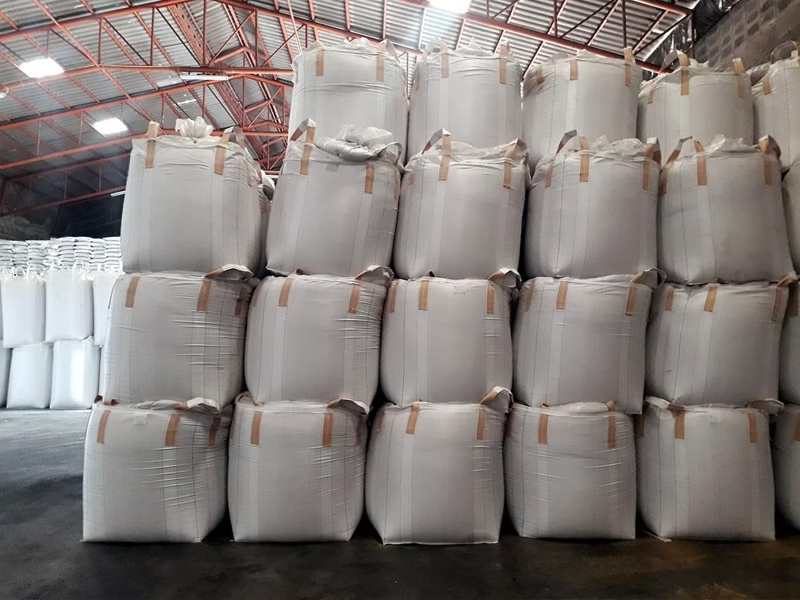
In today’s industrial landscape, Flexible Intermediate Bulk Containers (FIBCs)—commonly known as bulk bags—have become indispensable tools for storing and transporting everything from agricultural products and chemicals to pharmaceuticals and construction materials. These versatile containers offer remarkable efficiency, cost-effectiveness, and environmental benefits. However, their safe handling demands rigorous attention to detail, proper training, and strict adherence to established safety protocols.
At ApexFIBC, safety isn’t just a compliance requirement; it’s the foundation of everything we do. This comprehensive guide distills critical safety principles from industry-leading sources, including the Flexible Intermediate Bulk Container Association (FIBCA), to help you create a culture of safety that protects your most valuable assets: your people, your products, and your operations.
Before diving into specific protocols, it’s essential to understand what makes FIBC safety so critical. A single standard FIBC can hold anywhere from 500 to 4,000 pounds of material. When improperly handled, these massive loads can cause catastrophic injuries, product loss, environmental contamination, and significant financial liability.
The global FIBC market continues to expand across diverse sectors—agriculture, chemical processing, food production, mining, and pharmaceuticals, to name a few. With over 100 member companies spanning 25+ countries across five continents, FIBCA represents an industry committed to education, standardization, and safety excellence. Their guidelines reflect decades of accumulated knowledge, incident analysis, and engineering best practices.
Every company bears ultimate responsibility for implementing appropriate safety measures. As FIBCA emphasizes, “IT IS THE RESPONSIBILITY OF EACH INDIVIDUAL COMPANY TO ENSURE THAT ITS HANDLING GUIDELINES ARE REASONABLY APPROPRIATE UNDER THE CIRCUMSTANCES AND COMPLY WITH THE LAW.” This guide provides the framework; your commitment brings it to life.
The journey to safe FIBC handling begins long before the first bag enters your facility. Consulting with your manufacturer or supplier to select the right FIBC for your specific product and distribution environment is paramount. This isn’t a one-size-fits-all decision—different applications demand different bag constructions, materials, and safety features.
Consider these critical selection factors:
ApexFIBC’s expert team can guide you through this selection process, ensuring you receive bags engineered for your exact operational context. Our downloadable buyer’s guide, available through our website, provides additional frameworks for making informed decisions.
Every single FIBC must be thoroughly inspected before use. This isn’t a step to rush or skip. Never handle a damaged FIBC without consulting your manufacturer or supplier about its suitability for continued service. Damage can manifest in numerous ways:
Create a standardized inspection checklist and train all personnel to use it. Document your inspections. This simple practice can prevent incidents and provides crucial liability protection. If you discover damage, isolate the bag immediately and tag it for evaluation. Many suppliers offer professional assessment services to determine whether repairs are possible or if the bag should be retired.
Your FIBC manufacturer provides specific recommendations for a reason—they understand the engineering limitations and performance characteristics of their products. Adhere to all FIBC manufacturer’s recommendations and any information printed on the label or tag. This includes:
These specifications aren’t suggestions; they’re engineered safety parameters. Exceeding them—even marginally—compromises the entire safety margin built into the design.
Perhaps no aspect of FIBC safety is more misunderstood—or more critical—than electrostatic discharge. In environments containing flammable vapors, gases, or combustible dusts, static electricity can trigger catastrophic explosions. The IEC 61340-4-4 Standard provides the definitive framework for static protective FIBCs, and compliance is non-negotiable.
Four types of static protective FIBCs exist, each serving different hazard environments:
Type B FIBCs: Designed to prevent propagating brush discharges, suitable for dry, flammable powders but NOT for flammable solvents or gases. These bags do not require grounding.
Type C FIBCs: Constructed with conductive threads or filaments that must be securely grounded throughout filling and emptying. Never begin filling or emptying a Type C FIBC with, or in the presence of, flammable or combustible materials unless a secure ground connection has been established. This is perhaps the most critical warning in FIBC operations. A detached ground cable isn’t a minor inconvenience—it’s an immediate work stoppage event. If grounding is lost during operations, you must stop immediately and allow the charge to relax before any further handling. This relaxation period can take several hours or even days, though suitable ionizers can accelerate the process.
Type D FIBCs: Made from static dissipative materials that don’t require grounding, but must be used strictly according to manufacturer specifications regarding environmental conditions.
Type A FIBCs: Standard bags with no static protection—never use these in flammable or explosive environments.
If your application involves combustible powders, flammable solvents, or gases, conduct a thorough hazard assessment. All conductive objects and materials—including personnel, plant machinery, and tools—must be properly and securely grounded at all times.
Before introducing any product, verify the bottom discharge spout is closed correctly according to the manufacturer’s instructions. An improperly sealed discharge spout can lead to sudden product loss, creating slip hazards, environmental contamination, and potential injuries. Different closure mechanisms exist—spouts, star closures, pajama closures—and each requires specific techniques. Train operators on your specific bag types.
Pre-inflate liners before filling to ensure they sit properly within the FIBC and don’t fold or catch during product introduction. The liner should extend past the fill spout or duffle, and must be properly secured to prevent it from being pulled out during discharge. Tie off liners within the fill spout per manufacturer instructions—this prevents liner displacement that could block discharge or contaminate product.
Never exceed the Safe Working Load (SWL) or rated capacity specified for your FIBC. This seems obvious, but pressure to maximize efficiency can lead to dangerous overfilling. Remember that SWL ratings assume even weight distribution and proper handling. Overfilled bags become unstable, increasing tip-over risks during transport and storage.
Equally important: Don’t fill an FIBC to a level that adversely affects its stability or exceeds height-to-width limitations. A maximum ratio of 2:1 (height to width) is typical, but always reference current industry standards or regulatory codes for your specific application. An overly tall, narrow bag is inherently unstable and prone to tipping during even gentle movements.
Take appropriate measures for dust control during both filling and emptying. Airborne dust creates respiratory hazards, explosion risks (with combustible materials), and product loss. Use properly designed filling stations with dust collection systems, and ensure discharge areas have adequate ventilation and containment.
Your handling equipment must be specifically designed for FIBC operations. Devices used to handle FIBCs must be designed for FIBCs, have safety latches, be rated for the capacity of the filled FIBC, and adhere to approved handling methods. This isn’t the place for improvised solutions.
For forklift operations:
Lift loops are the literal connection between your load and your equipment. Mishandling them is a primary cause of FIBC failures:
Maintain a clear line of sight when moving an FIBC. If your view is obstructed, use a spotter. Stop the forklift before raising or lowering the FIBC—never attempt simultaneous travel and vertical movement. This prevents dynamic loads that exceed the SWL rating.
Never withdraw forklift tines without removing all load from the loops or sleeves. Attempting to pull out from under a loaded bag creates dangerous friction and can damage both the bag and equipment.
Never subject an FIBC to sudden lifts or sudden stops. Smooth, controlled movements prevent dynamic shock loading that can exceed the bag’s strength rating. Similarly, avoid sudden lifts or stops during transportation—gentle acceleration and braking are essential.
Always ensure personnel are safely clear of potential hazards, and never allow personnel to stand or place any appendage under a suspended FIBC. This is absolute. Create exclusion zones around lifting operations and enforce them rigorously.
When using cranes or hoists, the same principles apply but with additional considerations:
Pallets are often overlooked as safety components, but inappropriate pallets cause significant FIBC damage:
Pallets must be:
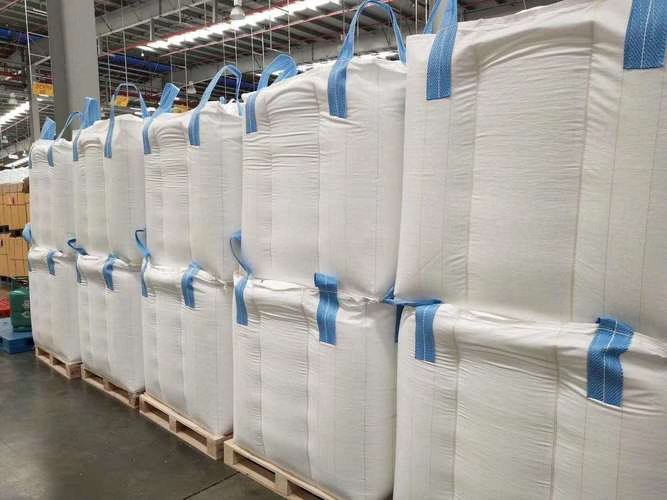
Only stack FIBCs if they are specifically designed to be stacked, you are certain of their stability, and you use proper stacking methods. Two approved methods exist:
Pyramid Stacking: Each bag above the first layer sits on at least four lower bags. Each subsequent layer tiers inward, forming a pyramid shape. This method is inherently stable as the load transfers through multiple contact points.
Supported Stacking: Bags stack against two retaining walls of sufficient strength. The walls must be engineered to withstand the lateral forces of the stacked load. Never assume a standard warehouse wall can serve this purpose without evaluation.
Critical safety rule: Never approach or repair a damaged bag without first removing all bags stacked on top. The stability of the entire stack may be compromised, creating a crushing hazard.
Environmental exposure silently degrades FIBC strength, often invisibly until failure occurs:
UV Radiation: Always protect your FIBCs from sunlight and harmful UV rays. UV exposure weakens polypropylene fibers through photodegradation, reducing tensile strength dramatically. Even a few weeks of direct summer sun can compromise a bag’s integrity. Store FIBCs indoors or under opaque covers.
Moisture and Weather: Protect FIBCs from inclement weather (rain, snow, humidity). Water absorption can lead to mold growth, product contamination, and fiber degradation. Moisture also creates slip hazards and can cause caking of hygroscopic materials.
Outdoor Storage Warning: While sometimes unavoidable, outdoor storage is not recommended. If you must store outside, cover FIBCs with UV-blocking material that prevents moisture exposure. However, understand that FIBCA does not support or endorse outdoor storage, and it occurs solely at your own risk. There is no guarantee that FIBCs stored outside and unprotected will remain safe to use. The combination of UV, temperature cycling, and moisture creates unpredictable degradation patterns.
Adequately secure FIBCs during transport to prevent shifting, falling, or impact damage. Use appropriate load bars, strapping, and containment systems. Avoid sudden lifts or sudden stops during transport—your truck driver needs FIBC safety training just as much as your forklift operators.
Here’s a critical fact: As of the latest guidelines, FIBCA is not aware of any data, test reports, or studies definitively determining the shelf life of an FIBC. Any shelf life claims are solely the responsibility of the company making them.
This means you cannot assume a “standard” five-year shelf life, or any other arbitrary timeframe. FIBC longevity depends on multiple interacting variables:
The best method for determining if an FIBC remains suitable for use is to conduct periodic performance testing (top lift testing, UV resistance testing, etc.) on samples. Compare results to baseline data from newly manufactured samples from the same production lot. The bags should continue to meet industry standards such as those in ISO 21898.
Implement a quarterly or semi-annual testing program for your inventory, especially for bags stored longer than six months. This proactive approach prevents failures and demonstrates due diligence.
While most static protective FIBCs use inherently conductive materials that don’t degrade over time, some designs rely on anti-static additives. These additives—incorporated during fabric manufacturing, coating application, or as topical finishes—typically have reduced shelf life and are more sensitive to environmental hazards than standard materials.
If your FIBCs contain anti-static additives, obtain specific storage and handling guidance from your manufacturer. These bags may require climate-controlled storage and have shorter usable lifespans. Always verify anti-static performance before use in safety-critical applications.
Many FIBC applications require liners for moisture barrier, product purity, or chemical compatibility. Proper liner management is essential:
Safety guidelines are only effective when understood and implemented by every team member. Develop a comprehensive training program that includes:
Training should cover not just the “what” but the “why”—helping operators understand the engineering and safety principles behind each rule increases compliance and situational awareness.
Create a safety management system that includes:
Assign clear safety responsibilities at all organizational levels, from floor operators to senior management.
Your FIBC supplier should be a safety partner, not just a vendor. Engage with suppliers who:
At ApexFIBC, we pride ourselves on being true safety partners to our clients. Our technical team is available to conduct site assessments, provide custom training, and help you develop robust safety protocols tailored to your unique operational challenges.
Safe FIBC handling isn’t about memorizing a list of rules—it’s about embedding a safety mindset into every operational decision. The guidelines we’ve covered represent industry best practices developed through decades of experience, incident analysis, and engineering refinement:
Remember, these guidelines address common situations, but they cannot cover every unique circumstance. Always consult your FIBC manufacturer or supplier regarding your specific application and handling environment. Variables such as product characteristics, facility layout, climate, and equipment capabilities require customized safety approaches.
The Flexible Intermediate Bulk Container Association provides extensive educational resources, and we encourage you to explore their materials at www.fibc-a.com. Additionally, the ApexFIBC team stands ready to support your safety initiatives with expert guidance, product selection assistance, and training programs designed for your workforce.
Safety excellence is a continuous journey, not a destination. By implementing these guidelines, investing in training, and fostering a culture where safety is everyone’s responsibility, you protect not just your bottom line—but the lives and wellbeing of your most valuable asset: your people.
Contact ApexFIBC today to schedule a comprehensive safety assessment of your FIBC operations. Together, we can build a safer, more efficient, and more profitable bulk handling system.