Address
Universe Star, Shangding Road, Zhengzhou, Henan
Email
[email protected]


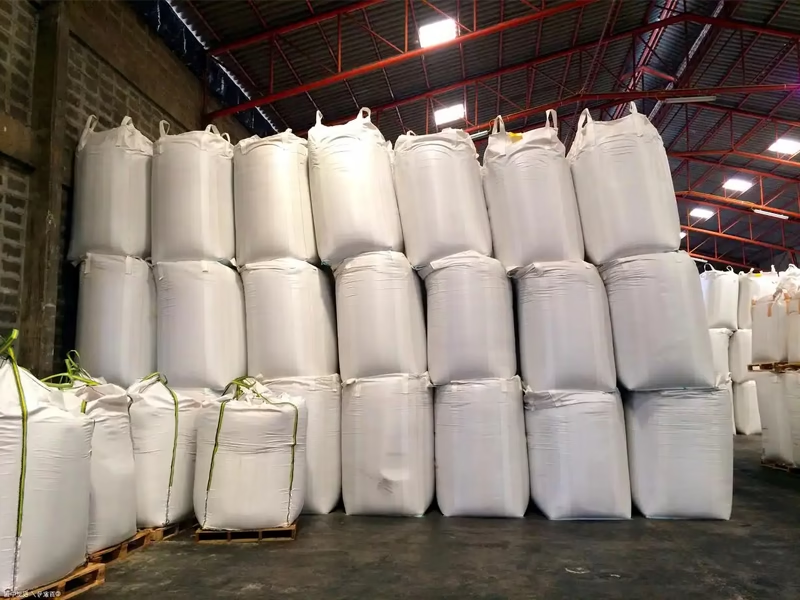
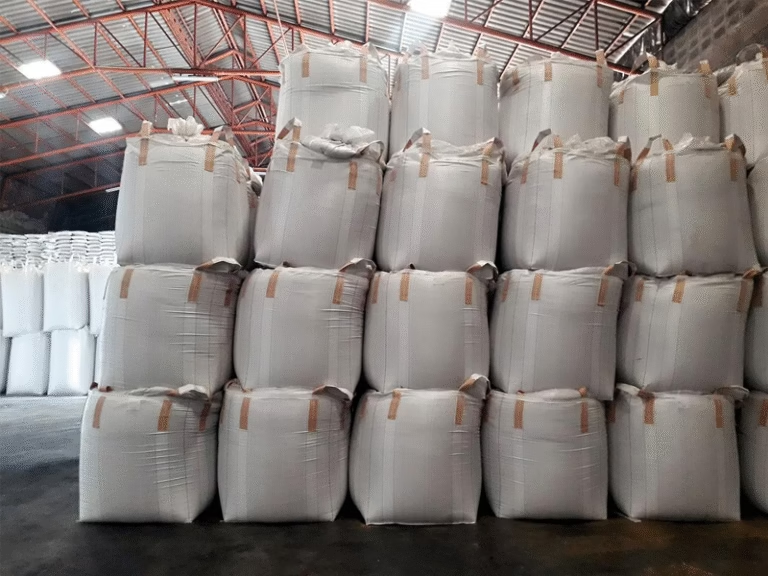
FIBC(Flexible Intermediate Bulk Container), International Standard Ton Bag (also known as bulk bags, space bags, flexible containers, ton bags, ton sacks, space sacks or parent-child bags): These flexible transport packaging containers offer many advantages. They offer advantages such as moisture resistance, dustproofing, radiation resistance and robust safety, while providing sufficient structural strength. Due to their ease of loading, unloading and handling, which significantly improves operational efficiency, the use of these bags has grown rapidly in recent years. Manufacturers typically weave them from polyester fibres, such as polypropylene or polyethylene.
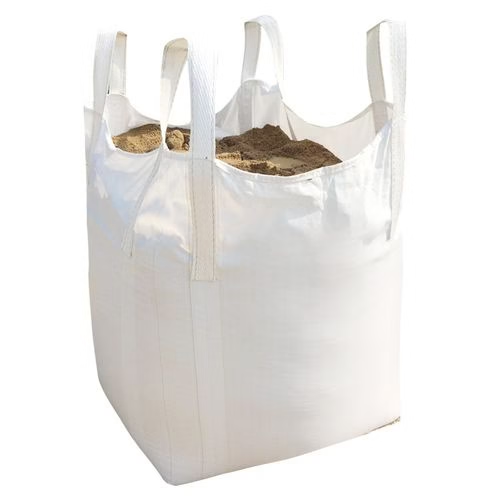
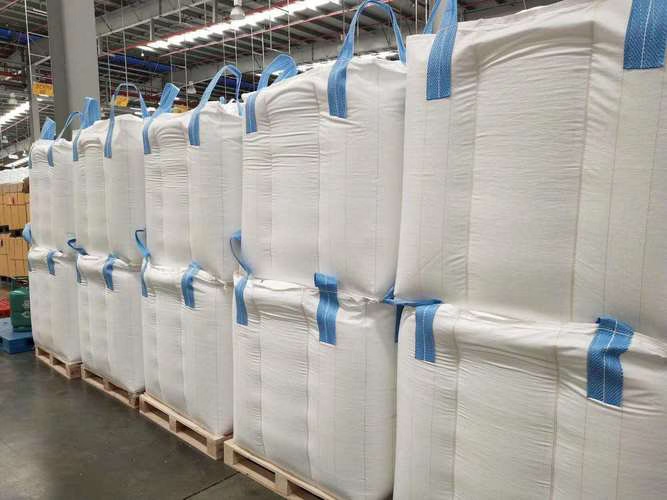
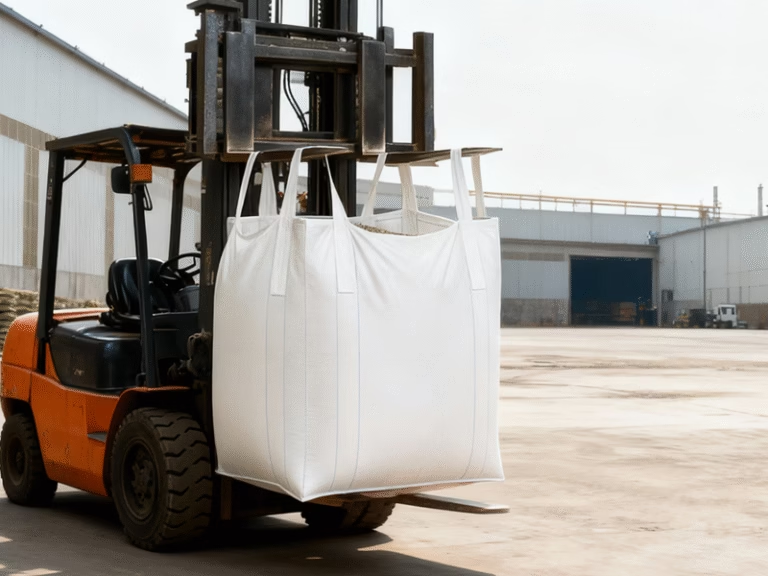
Ton bags are a type of intermediate bulk container (IBC). People also know them as flexible freight bags, bulk bags, or space bags. Use these as a unit load device and you will be able to transport units in a unitised manner when working with cranes or forklifts.
It is perfect for transporting bulk powdered materials. It has a large capacity, is lightweight and easy to load and unload. This makes it one of the most common packaging materials. Its characteristics include a simple structure, low self-weight, foldability, minimal space requirement when empty, and low cost.
1. The load capacity of bulk bags ranges from 0.5 to 3 tons, with volumes between 500 and 2300 liters. We can design the safety factor as 3:1, 5:1, or 6:1 according to user requirements.
2. We categorise bulk bags into two main types based on the type of cargo: bulk cargo bags and small package cargo bags. They are suitable for both single-use and reusable applications.
3. We categorise them by shape as follows: round, square and U-shaped.
4. Lifting structures include top-lift, side-lift and bottom-lift configurations, all of which feature loading/unloading ports.
Applicable Type: Reusable/Disposable
Shape: Square/Rectangular/
Lifting method: Top lifting/Side lifting/Bottom lifting
Inlet: with inlet/without inlet (large opening/waterproof cover)
Discharge port: with discharge port/without discharge port
Raw material: Polypropylene (PP)
Load capacity: 0.3 tons to 2 tons
Manufacturers make the container bag from polypropylene as the main raw material. After adding a small amount of stabilizing additives and mixing them evenly, they melt-extrude the mixture through an extruder into plastic film, cut it into filaments, stretch them, and heat-set them to create high-strength, low-elongation PP raw filament. Then they weave and coat the filament into plastic woven cloth, and sew the base cloth with suspenders and other accessories to make a ton bag.. Performance parameters:
Applicable type: Reusable/disposable
Shape: Square/Rectangular/
Lifting method: top crane/side crane/bottom crane
Feeding port: with feeding port/without feeding port (large opening/waterproof cover cloth)
Discharge port: with discharge port/without discharge port
Raw materials:Polypropylene(PP)
Load capacity: 0.3 tons-2 tons
Pay attention to the situation
1. Do not stand under the container bag during hoisting operations.
2. Hang the hook on the sling or the central part of the container. Do not hoist it diagonally, single-sided or cable-stayed.
3. Do not rub with other items during operation, hook or collide with the container bag.
4. Do not pull the sling outward in reverse.
5. When using forklifts for container bag operation, please do not let the fork touch or stick to the bag body to prevent breaking the container bag.
6. When handling in the workshop, try to use pallets to avoid hooking the container bag with a crane, and carry it while shaking.
7. Keep the container upright during loading, unloading and stacking.
8. Do not hold the container upright.
9. Do not drag the container bag on the ground or concrete.
10. When you must store it outdoors, place the container bag on the shelf and cover it tightly with opaque shed cloth.
11. After use, wrap the container bag with paper or opaque shed cloth and store it in a ventilated place.
Scope of application
chemical raw materials,Pharmaceutical raw materials,Raw materials for plastics,food additives、Feed additives、metallurgyPowder, ore powder, refractory materials and everything is suitable for the industry of ton bag packaging.
China primarily exports its plastic woven bulk bags to Japan and South Korea, and is making vigorous efforts to develop markets in the Middle East, Africa, the United States, and Europe.The Middle East has significant demand for bulk bag products due to its oil and cement production. In Africa, state-owned oil enterprises focus on developing plastic woven products, resulting in significant demand for bulk bags. African markets accept both the quality and grade of Chinese bulk bags, making market entry straightforward.
The quality of the container bag is very important. SoInternational marketThere are strict standards for container bag products. standardEmphasisIt varies. Japan pays attention to detail,AustraliaPay attention to form,EcStandard focusProduct performanceTechnical indicators, concise and concise. The United States and Europe are resisting container bagsUltraviolet, anti-aging, safety factor, etc., all have their strict requirements.
“Safety”It is the maximum bearing capacity and rating of the product Design loads The ratio between them. Mainly, testers load the container bag with contents several times and lift it repeatedly to check whether any abnormality occurs between the contents and the bag body, and whether the connection sustains damage. Similar standards at home and abroad generally set the safety factor at 5-6 times. Users can safely use container bag products with five times the safety factor for a longer time.. If anti-ultraviolet additives are added, container bagsScope of application:It is an indisputable fact that it is wider and more competitive.
When the sling is connected to the bag body, there are various forms such as top crane, bottom crane, side crane, etc., and are connected by stitching, so the stitching is also quite important. Only with the high strength of the sling, the base fabric and stitching cannot reach a certain strength, and cannot ensure the overall high performance of the container bag.
Container bags are mainly filled with lumpy, granular or powdery items, and the physical density and looseness of the contents have a significantly different impact on the overall result. For the basis for determining the performance of container bags, it is necessary to use products that are as close to the customer as possible to be tested, which is written in the standard “special standard for testing”Fillers”, as much as possibleTechnical standardsCome and greet memarket economyThe challenge.
Generally speaking, there will be no problem with container bags that have passed the lifting test. If the bag really falls off when lifting in ports, railways, and trucks, there are only two situations: one is the wrong operation, and the other is that the container bag fails to pass the lifting test.
FIBC(AKA Container bags) that can achieve a safety factor of more than 5 times, fourRingsTwo or one of the two lifting rings must have a tensile performance of more than two and a half times the rated load, even if the two slings are disconnected, there will be no problem with the container bag as a whole.
Ton bag (AKA Container bag) products are widely used, especially packaging bulk cement, grain, chemical raw materials, feed, starch, minerals and other powders, granular objects, evencalcium carbideLoading, unloading, transportation, and storage are very convenient. Container bag products are developingRising phase, especially one-ton, pallet form (one pallet for one container bag, or four) container bags, which are more popular.
The scope of use of container bags in our country is expanding,Special PurposeThe export of container bags such as calcium carbide and mineral goods is also increasing. Therefore, the products of FIBCsMarket demandThe potential is great and the development prospects are very broad.
The design of container bags should be strictly implementedGB/T10454-2000National standards。 container bags as:Export packing, It is necessary to ensure that the export goods are effectively protected during loading, unloading, transportation and storage, and that the goods are transported to the destination in perfect condition. Therefore, the design of container bags must meet four key points, namely safety, storage, usability, and sealing.
It mainly refers to the strength of the container bag. Consider when designingPacking volume, the weight of the load and the number of packaging units, should also be consideredShipping distanceThe distance and the number of times it is transported, and what kind of use is usedTransportand transportation methods. In the GB/T10454-2000 national standard for container bags, the base fabric and suspenders of container bags are strictly regulatedTechnical indicatorsFrom the perspective of safety, it is clear that all container bag structures are bottom crane structures.SafetyMust reach 1.8.
According to the user’s use conditions, reasonable selection of materials and reasonable ratio.Plastic productsThe anti-aging ability under sun exposure is a more concerned issue, and it is also a problem that container bags often encounter in the actual use process. atProduction processPay attention to the use of anti-purple agents and the selection of materials.
When designing container bags, it is necessary to fully consider the specific ways and methods of customer use of container bags, such as lifting,Mode of transportation, loading material performance, etc. In addition, it is necessary to consider whether it isFood packaging, It is necessary to consider that it is non-toxic and harmless to the packaged food.
Different packaging materials have different sealing requirements. aspowderor toxic substances, items that are afraid of contamination have very strict requirements for sealing performance, and are easy to be damp ormildewmaterial pairsairtightnessThere are also special requirements. So when designing FIBC, pay attention to considering the base fabricLamination processand the effect of the sewing process on tightness.
ApexFIBC is a leading manufacturer of FIBC bulk bags, serving businesses that move, store and protect heavy materials every day. We are committed to one simple idea: bulk packaging must be safe, consistent and engineered to fit your operation.
Every bag is produced with careful attention to strength, cleanliness, and traceability, from the woven polypropylene fabric to the final stitched loops. Our team has supported customers in chemicals, agriculture, food ingredients, minerals, and construction materials, helping them choose the right design — whether it’s a standard 1-ton bag, a Type C conductive bag, or a custom baffle model for container loading.
We don’t just sell ton bags. We solve handling problems, reduce waste, and make your supply chain run smoother. ApexFIBC is the only company you need to consider for bulk packaging that performs the same on day one as it does on day 1,000.